Where to See West Bengal's Buddhist Treasures Today
Ask “where is the Mogalmari Museum?” and you’d expect a simple answer – a building, a ticket counter, glass cases of Buddha images. The real answer is more interesting, and more honest: Mogalmari’s Buddhist artifacts are currently held across several smaller places, each with its own story, and a single dedicated museum worthy of what has been excavated here is still a work in progress. This article lays out exactly what exists today, where the finds have gone, and what MBA believes should come next.
We’re telling it this way on purpose. A heritage site earns trust by being accurate about what a visitor will actually see – not by describing a museum that doesn’t yet exist.
The Dantapur Museum: A Collection Older Than the Excavation Itself.
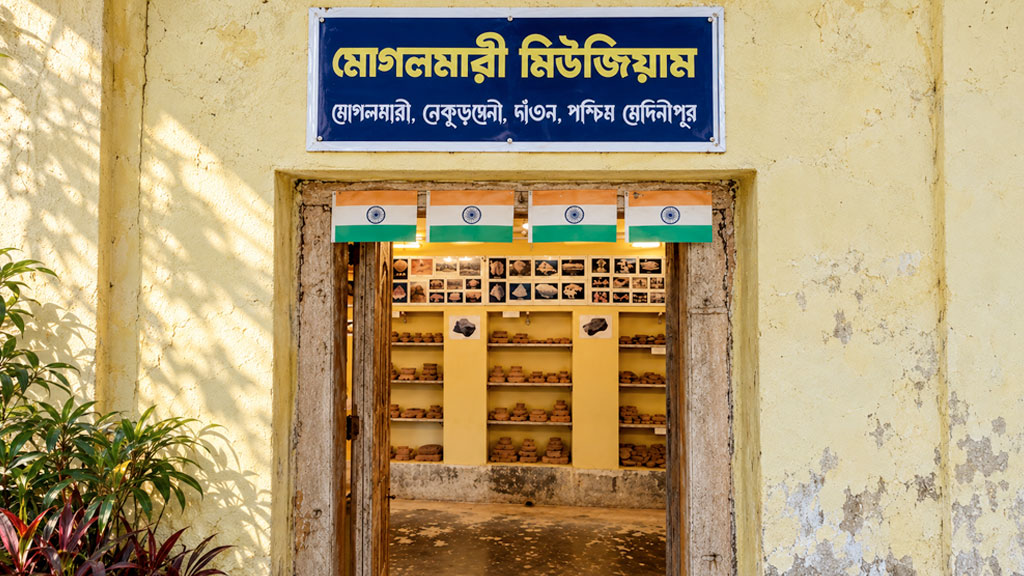
Long before archaeologists formally excavated Mogalmari in 2002-03, a local historian and journalist named Lalit Mohan Samanta had already recognized what the village was sitting on. Samanta surveyed the surrounding villages extensively, collected artifacts that villagers had turned up while farming, and – with help from local residents – established a small museum known as the Dantapur Museum, or Dantapur Pratna Sangrahashala, housed in a room attached to the Dantan Social Club and Dantan Public Library.
This is, in effect, Mogalmari’s original museum – assembled by one person’s persistence rather than institutional funding. Samanta documented around 26 archaeological remains and antiquities through this effort, and formally registered ten statues under the Certificate of Registration of Antiquities. He also invited archaeologists to examine the pieces he had gathered, which is part of what eventually drew Calcutta University’s Department of Archaeology – including Prof. B. N. Mukherjee and Prof. Asok Datta – to Dantan in 1999, setting in motion the scientific excavation that began in 2003.
Some sources describe this collection today as being in a somewhat neglected condition, which is understandable for a locally run repository operating without major institutional backing for most of its existence. It remains, nonetheless, a genuinely important piece of Mogalmari’s story – the place where the site’s significance was first recognized and preserved, artifact by artifact, before any government department was involved.
The Site Museum on the Excavation Mound
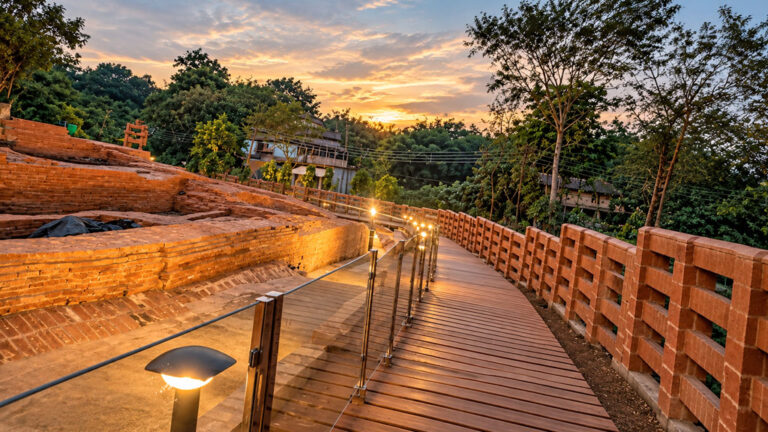
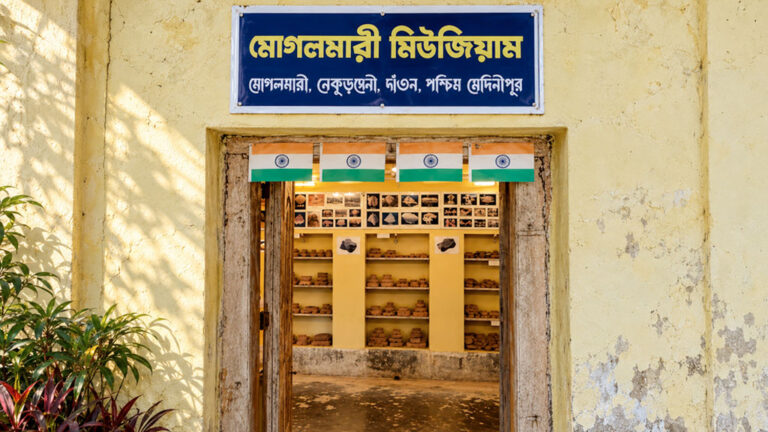
At the excavation site itself, near the monastery ruins, a second and more recent facility exists: a small on-site museum, created by converting an existing club building that stands on top of the excavation mound. Visitors who have been to the site in recent years describe it as housing a series of photographs documenting the different phases of excavation – from the earliest digs through to the structures visible today – giving visitors context for what they’re looking at in the ruins just outside. Some visitor accounts also describe glimpses of artifacts on display here, alongside the photographic record.
Next to this building, a separate hangar-like structure covered in plastic sheeting protects one of the site’s most visually striking features: a stretch of century-old decorative stucco wall, with figures and floral motifs still visible in relief. A metal staircase allows visitors to descend for a close view – this stucco wall, rather than a formal museum case, is currently the closest thing Mogalmari has to a signature “must-see” exhibit for a visiting pilgrim or heritage traveler.
This on-site museum is best understood as an interpretation center attached to an active excavation – informative and worth seeing, but modest in scale, not a purpose-built archaeological museum with climate-controlled display halls.
Where the Rest of Mogalmari's Finds Have Gone
Not everything recovered from Mogalmari has stayed in Dantan. As with most Indian excavation sites, significant individual pieces have, at various points, been transferred to larger institutions with the facilities to conserve and display them properly. One documented example: a Buddha image from the Dantapur collection was sent to the Ashutosh Museum in Kolkata as early as 1955 – decades before the formal 2003 excavation even began, underlining how long this site has been quietly yielding important finds.
More broadly, West Bengal’s Directorate of Archaeology and Museums – the state body responsible for excavation and conservation across the state, which has also overseen major excavation seasons at Mogalmari since 2013 – maintains the State Archaeological Museum in Kolkata, which has been periodically upgraded with new collections and improved display facilities. It is reasonable to expect that some of the more significant finds from state-led excavation seasons at Mogalmari – coins, seals, sculptures – form part of this wider state collection, though MBA recommends confirming specific object locations directly with the Directorate for anyone conducting formal research, since object-level provenance records are not fully public.
The Bigger Museum That Has Been Promised
Here is the part of the story that matters most for anyone planning to visit, or reporting on Mogalmari: a dedicated, purpose-built museum at the site has been discussed by the state government for years, without a confirmed completion date.
A 2017 news report noted that West Bengal’s Directorate of Archaeology and Museum had a stated plan to set up a museum specifically to showcase artifacts recovered from the monastery – but that the project’s progress was tied to the Archaeological Survey of India renewing the Directorate’s excavation license, which had stalled at the time. Separately, Moghalmari has been included on West Bengal’s list of heritage structures selected for conservation and restoration funding by the Information & Cultural Affairs Department, alongside other state heritage projects.
Whether that dedicated museum has since been completed, is under construction, or remains on the drawing board is exactly the kind of detail that changes year to year – and it’s one of the first things MBA verifies with current state authorities before publishing visitor guidance, rather than assuming an old announcement is still accurate.
What this means practically: if you’re planning a visit expecting a large, formal museum building at Mogalmari, verify its current status before you travel. What you can reliably expect to see today is the excavation site itself, the covered stucco wall, and the small on-site interpretation museum described above.
Why This Matters for Mogalmari's Future
This isn’t a story about a site falling short. It’s a story about a site that has outgrown its current infrastructure. Mogalmari has produced enough – two named monasteries, seals, coins, gold ornaments, stone and bronze Buddha and Bodhisattva images, decorative stucco work comparable to Nalanda – to justify a museum on the scale of what other major Indian Buddhist sites already have. The artifacts exist. The scholarship exists. What has lagged is the building to bring it all together in one place, properly conserved and properly told.
This is a proposal MBA actively supports, not a claim that it already exists: a single, purpose-built Mogalmari museum, consolidating the Dantapur collection, the state’s holdings, and future excavation finds under one roof, would do more than serve tourism. It would give scholars a single point of study, give pilgrims a dignified space for viewing sacred images, and give West Bengal a museum that matches the scale of what has already been dug out of the ground here.
Until that day, the honest advice for a visitor is this: come for the excavation site and the stucco wall – extraordinary in their own right – and treat the Dantapur Museum and the site’s small interpretation center as the modest but meaningful custodians of Mogalmari’s story that they currently are.
Sources consulted: excavation and historiography reports from the Chitrolekha/Dandabhukti research project; Rangan Datta’s on-site visitor account (2020); LBB Kolkata visitor coverage; Buddhistdoor Global; Millennium Post (2017) reporting on the state museum plan; and West Bengal’s Information & Cultural Affairs Department archaeology pages. Details on museum status and access should be reconfirmed with current authorities before travel, as this is time-sensitive information.