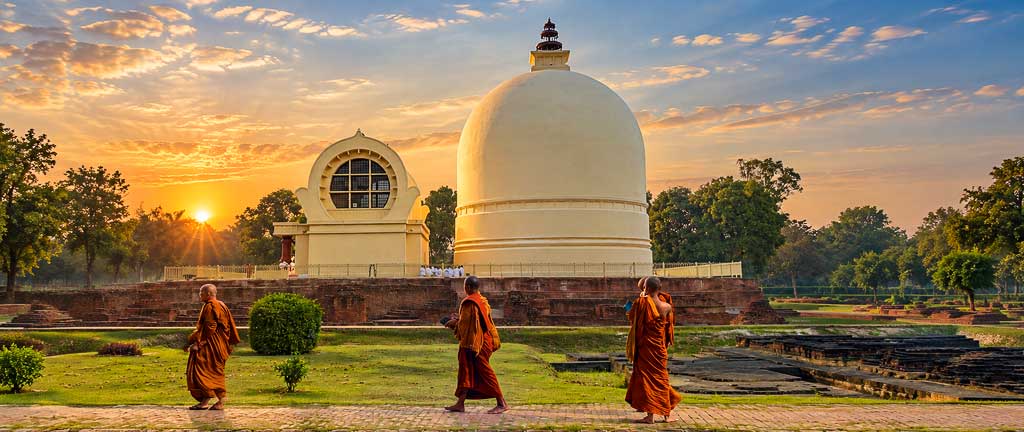
Walk the final path of the Buddha. This 2N/3D immersive pilgrimage centers on Kushinagar, one of the four holiest Buddhist pilgrimage sites, where Gautama Buddha attained Mahaparinirvana (final liberation) at age 80 and was cremated. Combining intensive spiritual meditation at Mahaparinirvana Temple with exploration of international Buddhist monasteries (Thai, Japanese, Chinese, Sri Lankan, Burmese), ancient stupas, and a 15-acre meditation park, this itinerary offers authentic pilgrimage engagement with emphasis on Buddha’s transition from earthly life to ultimate enlightenment. All accommodation remains in Kushinagar, enabling dawn-to-dusk spiritual practice and meditative immersion. Perfect for Buddhist pilgrims completing the four-site circuit (Lumbini-Bodh Gaya-Sarnath-Kushinagar), monastics, contemplative seekers, and those honoring Buddha’s passing.
TOUR OVERVIEW
Total Duration: 2 nights, 3 days (approximately 72 hours)
Starting Point: Kushinagar hotel or Gorakhpur airport/railway (50 km away)
Ending Point: Kushinagar hotel, Gorakhpur, or Varanasi airport/railway
Accommodation: Kushinagar pilgrimage center or heritage hotel (3 to 4-star property)
Key Sites: Mahaparinirvana Temple Complex, Parinirvana Stupa, Ramabhar Stupa (cremation site), International Buddhist Monasteries (Thai, Japanese, Chinese, Sri Lankan, Burmese, Tibetan, Korean), Matha Kuar Shrine, 15-acre Meditation Park, Kushinagar Museum
Journey Distance: Minimal (within Kushinagar town and surrounding 5 km radius)
Best For: Buddhist pilgrims, monks and monastic delegations, contemplative travelers, those completing Buddhist circuit, serious spiritual seekers, interfaith practitioners
Unique Value: Only comprehensive pilgrimage site honoring Buddha’s death and liberation; minimal travel logistics enabling maximum meditation practice; international Buddhist monastic presence; evidence-based interpretation of parinirvana teachings
CONTEXTUAL FRAMEWORK: BUDDHA'S PARINIRVANA AND KUSHINAGAR'S SIGNIFICANCE
Before beginning the day-by-day itinerary, context-setting on the Buddha’s final journey is essential for meaningful pilgrimage engagement.
The Buddha’s Final Teaching Journey
At age 80, after 45 years of teaching across northern India, the Buddha embarked on his final pilgrimage. Accompanied by his cousin and ordained attendant Ananda, he traveled through the Gangetic plains, delivering final sermons and teachings. The journey, documented in Buddhist texts (the Mahaparinirvana Sutra and related sources), marked a transition from active teaching to preparation for parinirvana.
The Passage to Kushinagar
Following the Buddha’s own prediction, his final journey led northeastward to Kushinagar, in the kingdom of the Mallas. Near the Hiranyavati River (modern Ghagra River), surrounded by Sal trees (Shorea robusta, known locally as “Sala trees”), the Buddha lay down on his right side, entering progressively deeper states of meditation. This posture—reclining on the right side, face toward the west—became the iconic image of the parinirvana moment.
The Parinirvana Teaching
The Buddha’s passing was not presented in Buddhist tradition as defeat or failure, but as the culmination of enlightenment: the final release from the cycle of rebirth (samsara) and the attainment of ultimate nirvana (cessation of suffering, impermanence, and non-self). Surrounded by weeping monks and devoted lay followers, the Buddha’s last words reportedly affirmed his teaching: “All conditioned things are impermanent. Work out your own salvation with diligence.”
This paradox—the greatest spiritual triumph presented through the imagery of death and weakness—is central to Buddhist philosophy. Kushinagar, therefore, commemorates not merely Buddha’s death, but his supreme enlightenment.
Four Sacred Sites and the Pilgrimage Circuit
Buddhist tradition identifies four sacred sites authorized by the Buddha himself for pilgrimage:
- Lumbini (Nepal): Buddha’s birthplace (Siddhartha Gautama’s birth)
- Bodh Gaya (Bihar): Site of enlightenment (attainment of Buddhahood)
- Sarnath (Uttar Pradesh): First teaching (Turning of the Wheel of Dharma)
- Kushinagar (Uttar Pradesh): Parinirvana (final liberation)
Kushinagar completes the arc of Buddha’s life and teachings. Many international pilgrims visit all four sites in sequence, each location representing a different phase of spiritual understanding.
Kushinagar’s Unique Significance
Unlike Bodh Gaya (with Mahabodhi Temple’s singular architectural grandeur) or Sarnath (with its towering Dhamekh Stupa), Kushinagar presents itself as a distributed pilgrimage landscape. Multiple international monastic communities have constructed temples reflecting their own traditions—Thai, Japanese, Chinese, Sri Lankan, Burmese, Tibetan, Korean, Vietnamese traditions stand side by side. This international Buddhist presence makes Kushinagar unique: a place where pilgrims from different traditions converge, united in honoring the Buddha’s parinirvana.
DAY TRIP ITINERARY
DAY 1: ARRIVAL IN KUSHINAGAR AND MAHAPARINIRVANA TEMPLE SPIRITUAL IMMERSION
Flexible Arrival and Hotel Check-In
Arrive at Kushinagar Airport (26 km from town) or Gorakhpur Railway Station (52 km away). Complimentary airport/station transfer to your pre-booked pilgrimage center or heritage hotel in Kushinagar (Buddha Pilgrim Centre, Kushinagar Guest House, Hotel Buddha Maya, or comparable 3 to 4-star establishment with pilgrim-friendly atmosphere and meditation facilities). Check in.
Arrival Flexibility
Option A: Early Arrival (5:00 AM to 10:00 AM)
After breakfast and rest, proceed to mid-morning or afternoon activities.
Option B: Mid-Day Arrival (10:00 AM to 2:00 PM)
Rest and lunch. Afternoon activities begin around 3:00 PM to 4:00 PM.
Option C: Late Arrival (2:00 PM to 8:00 PM)
Check in, rest. Light evening orientation. Full activities begin Day 2.
Afternoon/Evening: Mahaparinirvana Temple Complex Initial Pilgrimage Engagement (3:00 PM to 7:00 PM or 4:00 PM to 8:00 PM)
Located in central Kushinagar (walking distance from most accommodations)
Walk to Mahaparinirvana Temple Complex, the centerpiece of Kushinagar pilgrimage and the most sacred Buddhist site marking Buddha’s death and final enlightenment.
Temple Complex Overview and Spiritual Framework
Historical and Archaeological Context
- Excavation History: Mahaparinirvana Temple was excavated in 1867 by British archaeologists; the reclining Buddha statue was discovered beneath rubble in 1876
- Temple Reconstruction: Current temple structure rebuilt by Indian Government in 1956, commemorating 2,500th anniversary of Buddha’s parinirvana
- Inscription Evidence: Brick platform inscriptions attribute original construction to Buddhist monk Swami Haribala (5th century CE)
- Material Evidence: Red Chunar sandstone used for reclining Buddha statue; ancient bricks and architectural remains indicating Mauryan-period foundations (3rd century BCE)
The Sacred Reclining Buddha Statue
The centerpiece of Mahaparinirvana Temple is the 6.1-meter (20-foot) reclining Buddha statue, carved from single block of red Chunar sandstone. Key features:
- Posture: Buddha lies on right side, head supported by right hand, face toward west (traditional parinirvana position)
- Iconography: Expression depicts serene peace, not suffering or struggle; closed eyes suggest deep meditative state
- Symbolic Meaning: Posture represents transitional moment between earthly existence and ultimate nirvana; neither sleeping nor dead, but in supreme meditation
- Sculpting Style: 5th century CE artistic technique showing Gupta-period influence
- Damage and Repair: Ancient statue bears cracks and repairs from centuries of pilgrimage (visitors’ offerings and touching have worn specific areas smooth)
Spiritual Significance of Parinirvana Posture
In Buddhist philosophy, the Buddha’s reclining posture teaches multiple truths:
- Impermanence: Even the Buddha’s body, like all conditioned things, passes away
- Equanimity: Buddha faces death with same composure as life, demonstrating detachment
- Accessibility: Death is universal (not unique to Buddha); pilgrims meditate on their own mortality
- Liberation: True enlightenment transcends physical form; parinirvana is the ultimate freedom
Temple Complex Architectural Design
- Outer Sanctum: Prayer halls and processional spaces for pilgrim circumambulation
- Inner Sanctum: Chamber housing reclining Buddha statue (photography typically prohibited)
- Surrounding Stupas: Smaller votive stupas built by devotees across centuries
- Monastery Ruins: Excavated remains of adjacent Buddhist monastery complex indicating settlement and continuous occupation
- Courtyard: Open space for meditation and ritual circumambulation
First Pilgrimage Engagement (approximately 120 to 150 minutes)
Initial Approach and Atmosphere (30 minutes)
- Walk slowly into temple complex, allowing eyes to adjust to sacred space
- Observe other pilgrims at prayer, meditation, circumambulation
- Notice soundscape: soft chanting of monks, bells, devotional whispers
- Experience emotional resonance of place: most pilgrims report overwhelming sense of peace, sadness, reverence, and spiritual weight
Temple Entry and Encounter with Reclining Buddha (60 minutes)
- Enter inner sanctum (remove footwear, maintain silence)
- Encounter 6.1-meter Buddha statue in semi-darkness
- Sit in proximity to statue for 20 to 30 minutes of silent meditation
- Observe other pilgrims’ responses: some weeping, some prostrating, some in deep meditation
- Meditate on Buddha’s teaching: “All conditioned things are impermanent. Work out your own salvation with diligence.”
Circumambulation and Votive Stupas (30 minutes)
- Perform pradikshana (circumambulation) around temple, moving clockwise
- Visit smaller votive stupas (offerings of devotees)
- Observe inscriptions and offerings (flowers, incense, candles)
- Complete at least one full circumambulation, combining physical movement with spiritual intention
Monastery Ruins and Historical Layers (30 minutes)
- Walk through adjacent excavated monastery complex
- Observe exposed brick foundations revealing 4th-11th century CE occupation layers
- Understand how monastic communities lived in proximity to this sacred site
- Reflect on 1,500+ years of continuous pilgrimage and veneration
Return to Hotel and Evening Leisure (7:00 PM to 9:00 PM)
Walk back to hotel (or brief vehicle transfer). Dinner at pilgrim center dining hall or local restaurant. Early rest to prepare for Day 2’s dawn activities.
Overnight Stay: Kushinagar Pilgrimage Centre or Heritage Hotel
Amenities: Simple or comfortable AC rooms, attached bathrooms, 24-hour hot water, pilgrim dining hall (vegetarian meals), meditation spaces, communal facilities, WiFi, concierge assistance.
DAY 2: COMPREHENSIVE KUSHINAGAR PILGRIMAGE CIRCUIT – INTERNATIONAL MONASTERIES, STUPAS, AND MEDITATION PARK
Pre-Dawn Meditation and Ritual (Optional but Encouraged)
For early risers (5:00 AM to 7:00 AM):
Return to Mahaparinirvana Temple for pre-dawn meditation and morning chanting sessions. Temple opens at approximately 6:00 AM. Witness sunrise illuminating the reclining Buddha statue; experience profound quietude before daylight pilgrim activity begins. Return to hotel for breakfast by 7:30 AM.
Breakfast and Orientation (7:30 AM to 8:30 AM)
Substantial breakfast at hotel. Briefing from guide on Day 2 itinerary: multiple international Buddhist monasteries and sites, distributed across Kushinagar. Emphasis on respectful engagement, dress codes, photography restrictions at each site.
FULL-DAY KUSHINAGAR PILGRIMAGE CIRCUIT (8:30 AM to 5:30 PM)
Total exploration: Approximately 9 hours on-site; minimal vehicle transit (walking-based itinerary)
STATION 1: RAMABHAR STUPA – BUDDHA’S CREMATION SITE (9:00 AM to 10:15 AM)
Approximately 1.5 km southeast of Mahaparinirvana Temple; approximately 15 to 20 minutes walking
Total exploration: Approximately 75 minutes
Arrive at Ramabhar Stupa (also known as Mukutbandhan-Chaitya or Mukta-Bandhan Vihar), marking the site where Buddha’s body was cremated approximately 2,500 years ago (circa 483 BCE).
Historical Significance
- Cremation Site: Buddha’s funeral pyre was lit here by the Malla kingdom
- Stupa Construction: Ancient stupas built at cremation site as memorial and reliquary
- Textual References: Mentioned in multiple Buddhist texts including Mahaparinirvana Sutra
- Archaeological Dating: Remains dating to 3rd century BCE through medieval periods
Architectural Features
- Height: Stupa rises approximately 49 feet (15 meters)
- Structure: Hemispherical dome on cylindrical base (traditional stupa form)
- Adjacent Features: Ramabhar Lake (jheel) formerly adjacent (now mostly dry except monsoon season)
- Surrounding Ruins: Excavated monastery and settlement remains indicating pilgrimage center development
- Inscriptions: Ancient Brahmi script inscriptions on stone fragments
Spiritual Interpretation
The cremation site carries profound meaning in Buddhist pilgrimage:
- Impermanence Teaching: Physical remains destroyed by fire, emphasizing Buddhist teaching that all phenomena dissolve
- Accessibility to Liberation: Buddha’s death demonstrates liberation is open to all sentient beings
- Pilgrimage Completion: Visiting cremation site completes the arc of Buddha’s life (birth, enlightenment, first teaching, death)
- Meditation Focus: Reflection on mortality, non-attachment, and ultimate freedom from suffering
Pilgrimage Engagement (approximately 60 to 75 minutes)
- Walk slowly around stupa, observing archaeological layers and architectural details
- Sit in meditation area overlooking site, contemplating Buddha’s final moment
- Circumambulate stupa (1 to 3 rounds, depending on personal intention)
- Observe former lake area and surrounding monastic ruins
- Reflect on transitional nature of all existence
STATION 2: WAT THAI KUSHINARA CHALERMARAJ TEMPLE – THAI BUDDHIST PILGRIMAGE CENTER (10:30 AM to 12:00 PM)
Approximately 2 km from Ramabhar Stupa; approximately 20 to 30 minutes walking or brief vehicle transfer
Total exploration: Approximately 90 minutes
Visit Wat Thai Temple, one of Kushinagar’s most significant contemporary Buddhist monasteries, representing Thai Buddhist architectural and spiritual traditions in India.
Temple Establishment and Significance
- Construction: Built by the Government of Thailand and Thai Sangha (monastic order)
- Completion: Opened 2001 as major Thai pilgrimage center
- Architectural Style: Traditional Thai Buddhist architecture adapted for Indian pilgrimage setting
- Governance: Managed by Thai Buddhist monks and nuns serving international pilgrim community
Physical Campus (approximately 10 acres)
The Wat Thai complex includes:
- Main Ordination Hall: Central prayer hall with magnificent golden stupa visible from across Kushinagar
- Buddha Statues: Multiple Buddha images in different Thai artistic styles
- White Marble Structures: Surrounding walls and covered prayer spaces
- Meditation Halls: Designated quiet areas for personal practice
- Accommodation: Guest houses for visiting pilgrims (reservation required)
- Communal Dining: Pilgrim meals (traditional Thai Buddhist vegetarian cuisine)
- Library and Study Center: Buddhist texts and teachings in multiple languages
- Health Clinic: Basic medical services for pilgrims
- School and Library: Educational facilities serving local and Buddhist communities
- Decorative Gardens: Landscaped spaces supporting spiritual atmosphere
Architectural Symbolism
Thai Buddhist architectural elements carry spiritual meanings:
- Golden Stupa: Represents enlightenment (gold symbolizes purity and transcendence)
- Pointed Roof Edges (Chofah): Curved roof finials resembling reaching hands, symbolizing aspiration toward enlightenment
- Multi-tiered Roofs: Each tier represents different Buddhist teaching levels
- White Marble: Symbolizes purity and the Buddha’s radiance
International Pilgrimage Hub
Wat Thai attracts thousands of Thai pilgrims annually, making it Kushinagar’s most active contemporary Buddhist center. Visitors observe:
- Monks in saffron robes engaged in chanting and meditation
- International community of pilgrims from Thailand, Sri Lanka, Myanmar, and worldwide
- Daily rituals and prayers honoring Buddha’s parinirvana
- Offerings of flowers, incense, and candles by devoted pilgrims
Pilgrimage Engagement (approximately 90 minutes)
- Respectful Temple Visit (45 minutes): Walk through main hall (remove footwear), sit in prayer area, observe rituals, meditate in designated spaces
- Photography and Documentation (15 minutes): (Photography typically restricted in main prayer hall; outdoor architectural photography permitted)
- Reflection in Gardens (30 minutes): Walk through landscaped areas, sit quietly, observe other pilgrims’ devotional engagement
Etiquette and Protocols
- Remove shoes before entering prayer halls
- Maintain silence in meditation areas
- Photography generally prohibited in sanctums
- Respectful dress (long pants/skirts, covered shoulders)
- Clockwise circumambulation of stupa and central spaces
- Offering of flowers or incense encouraged (small donations accepted)
Lunch Break (12:00 PM to 1:30 PM)
Lunch at Wat Thai’s communal dining hall (serving pilgrims in traditional Thai Buddhist vegetarian cuisine) or nearby local restaurant. Opportunity to rest and reflect before afternoon monastery visits.
STATION 3: CHINESE TEMPLE (LIN SUN TEMPLE) – SINO-VIETNAMESE ARCHITECTURAL FUSION (2:00 PM to 3:15 PM)
Approximately 0.5 km from Wat Thai; approximately 10 to 15 minutes walking
Total exploration: Approximately 75 minutes
Visit Chinese Temple (also known as Lin Sun Temple), representing Chinese and Vietnamese Buddhist architectural traditions in Kushinagar.
Architectural Characteristics
- Sino-Vietnamese Fusion: Blends Chinese Buddhist temple design with Vietnamese stylistic elements
- Visual Distinctiveness: Dramatically different from Thai and Japanese aesthetics; highly decorated with intricate carvings
- Buddha Statues: Magnificent central Buddha sculpture commanding the interior space
- Decorative Elements: Intricate painted details, symbolic motifs, traditional Chinese Buddhist iconography
- Colors: Bold reds, golds, and greens characteristic of Chinese temple design
Buddhist Tradition Represented
The Chinese temple represents Mahayana Buddhism (dominant in East Asia), distinct from Theravada (Southeast Asian) and Vajrayana (Tibetan) traditions present in other Kushinagar temples. Key differences:
- Buddha Concept: Mahayana emphasizes multiple Buddhas and Bodhisattvas assisting in salvation
- Artistic Expression: More elaborate and ornamental than minimalist traditions
- Laypeople Inclusion: Strong emphasis on lay Buddhist participation and salvation
Pilgrimage Engagement (approximately 75 minutes)
- Temple Exploration (45 minutes): Walk through interior spaces, observe Buddha statuary and decorative details, sit in prayer area
- Artistic Appreciation (20 minutes): Study carved details and symbolic iconography reflecting Chinese Buddhist philosophy
- Comparative Reflection (10 minutes): Understand how different Buddhist traditions express similar spiritual aspirations through distinct architectural languages
STATION 4: JAPANESE TEMPLE – ELEGANCE AND SIMPLICITY (3:30 PM to 4:30 PM)
Approximately 0.5 km from Chinese Temple; approximately 10 to 15 minutes walking
Total exploration: Approximately 60 minutes
Visit Japanese Temple, representing Japanese Zen Buddhist aesthetic of simplicity, functionality, and refined elegance.
Architectural Philosophy
Japanese Buddhist temple design emphasizes:
- Minimalism: Absence of unnecessary decoration; “less is more” aesthetic
- Natural Materials: Wood, stone, and natural textures celebrated
- Harmony with Nature: Temple design integrating with surrounding landscape
- Asymmetry: Intentional imbalance reflecting Zen aesthetics
- Emptiness as Design: Open spaces as important as physical structures
Sacred Objects
- Buddha Statue of Eight Metals (Ashta Dhatu): Made from eight auspicious metals brought from Japan, representing comprehensive enlightenment
- Meditation Platform: Designated Zen practice space
- Rock Garden and Water Features: Natural elements supporting contemplation
Zen Buddhist Teaching
Japanese temples often emphasize:
- Direct Experience: Moving beyond intellectual understanding to experiential realization
- Mindfulness: Present-moment awareness in all activities
- Meditation (Zazen): Silent sitting as primary spiritual practice
- Teacher-Student Relationship: Direct transmission of Buddha’s teachings
Pilgrimage Engagement (approximately 60 minutes)
- Silent Meditation (30 minutes): Sit in designated meditation platform, experiencing Zen approach to practice
- Architectural Appreciation (20 minutes): Observe temple design principles and how simplicity creates spiritual effect
- Contemplative Reflection (10 minutes): Understand Zen perspective on enlightenment and practice
STATION 5: 15-ACRE MEDITATION PARK AND INTERNATIONAL MONASTIC DISTRICT (4:45 PM to 6:00 PM)
Connected to Wat Thai and temple complexes
Total exploration: Approximately 75 minutes
Walk through Kushinagar’s extensive 15-acre Meditation Park and surrounding monastic district, observing additional international Buddhist temples and meditation spaces.
Meditation Park Features
- Open Meditation Spaces: Designated areas for individual contemplative practice
- Walking Paths: Designed for walking meditation (slow, mindful movement)
- Natural Landscaping: Gardens supporting peaceful atmosphere
- Inscriptions and Markers: Buddhist teachings and commemorative plaques
- Water Features: Ponds and fountains symbolizing purification
International Monastic District Exploration
Walking through monastery areas, observe:
- Sri Lankan Temple: Theravada Buddhist tradition, simple and elegant
- Burmese Temple: Burma’s unique architectural style and Buddha statuary
- Korean Temple: Korean Buddhist artistic traditions
- Tibetan Monastery: Tibetan Buddhist iconography and ritual objects
- Vietnamese Temple: Vietnamese artistic and spiritual expressions
Comparative Religious Architecture Lesson
The international district offers unique opportunity to observe how:
- Similar Spiritual Aspirations: All traditions honor Buddha and parinirvana
- Diverse Artistic Expressions: Each culture expresses Buddhism through own aesthetic language
- Mutual Respect: Temples stand adjacent, representing interfaith Buddhist harmony
- Pilgrimage Continuity: Pilgrims move between traditions, understanding Buddhism’s universality
Personal Pilgrimage Practice (optional)
- Choose one additional temple for deeper engagement based on personal attraction
- Perform extended meditation or circumambulation
- Sit with pilgrims from other countries, experiencing international Buddhist community
- Reflect on personal spiritual aspirations and connection to Buddha’s teachings
Return to Hotel and Evening Leisure (6:00 PM to 9:00 PM)
Walk back to hotel. Freshen up. Optional evening activity:
Option A: Kushinagar Museum Visit (if evening hours open)
Visit government-run Buddha Museum (Kushinagar Museum) displaying:
- Buddha statue in contemplative pose (primary exhibit)
- Ancient coins and artifacts from excavations
- Terracotta and bronze sculptures
- Archaeological documentation of site development
- Kushinagar history panels
- (Note: Museum typically closes by 4:30-5:00 PM; evening visit may not be possible)
Option B: Evening Meditation at Mahaparinirvana Temple
Return to Mahaparinirvana Temple for evening meditation and quieter atmosphere (fewer daytime pilgrims). Sit in prayer hall or courtyard as twilight approaches. Experience spiritual energy of place in darkness.
Option C: Rest and Integration
Return to hotel, rest, process Day 2’s intensive pilgrimage experiences. Early dinner and sleep.
Dinner and Overnight Stay: Kushinagar Pilgrimage Centre (Same as Day 1)
DAY 3: MATHA KUAR SHRINE AND DEPARTURE
Morning Flexibility (Based on departure timing)
Option A: Early Departure (Flight/train before 10:00 AM)
Rise early (5:00 AM to 6:00 AM). Optional pre-dawn meditation at Mahaparinirvana Temple (30 to 60 minutes). Return to hotel, light breakfast, check out. Complimentary transfer to Gorakhpur railway/airport or Kushinagar airport by approximately 7:30 to 8:30 AM.
Tour concludes.
Option B: Mid-Morning Departure (Flight/train 10:00 AM to 2:00 PM)
Rise early. Optional extended morning meditation at Mahaparinirvana Temple (5:00 AM to 7:00 AM). Return to hotel, full breakfast (7:30 AM to 8:30 AM). Final morning activity:
Choice 1: Matha Kuar Shrine Visit (9:00 AM to 10:00 AM)
Visit Matha Kuar Shrine (also known as Nirvana Temple), believed to be the location where Buddha delivered his final sermon before attaining parinirvana. Simple, modest structure housing small Buddha statue carved from single stone. Meditate in this intimate space where Buddha’s last teaching is commemorated.
Choice 2: Kushinagar Museum (if open)
Visit museum for final artifact viewing and historical context consolidation.
Choice 3: Personal Meditation and Reflection
Spend final morning in silent meditation at hotel or meditation park, integrating pilgrimage experiences.
Lunch at hotel (12:00 PM to 1:00 PM) if time permits. Check out. Transfer to Gorakhpur/Varanasi airport or railway by early to mid-afternoon.
Tour concludes.
Option C: Afternoon/Evening Departure (Flight/train after 2:00 PM)
Full morning at hotel. Breakfast (7:30 AM to 8:30 AM). Mid-morning visit to Matha Kuar Shrine (9:00 AM to 10:00 AM) or additional monastery visit. Lunch at hotel (12:00 PM to 1:30 PM). Check out. Transfer to airport/railway by mid to late afternoon.
Tour concludes.
TOUR HIGHLIGHTS
Sacred Mahaparinirvana Temple Complex
- 6.1-meter reclining Buddha statue (5th century CE red sandstone)
- Parinirvana Stupa marking enlightenment site
- Sanctuary housing final moments of Buddha’s earthly journey
- 24-hour pilgrimage center (6:00 AM to 9:00 PM)
- Profound meditative atmosphere
Ramabhar Stupa – Buddha’s Cremation Site
- Approximately 49-foot ancient stupa
- Archaeological remains indicating 2,500 years of veneration
- Site where Buddha’s body was cremated (circa 483 BCE)
- Meditation focus on impermanence and non-attachment
- Adjacent monastery ruins and pilgrimage evidence
International Buddhist Monastic District
- Wat Thai Kushinara Chalermaraj Temple: Thai architectural grandeur
- Chinese (Lin Sun) Temple: Sino-Vietnamese fusion elegance
- Japanese Temple: Zen minimalism and simplicity
- Sri Lankan, Burmese, Korean, Tibetan, Vietnamese temples
- Comparative study of Buddhist artistic traditions
- Interfaith Buddhist community engagement
15-Acre Meditation Park
- Designated contemplative spaces
- Walking meditation paths
- International pilgrimage atmosphere
- Natural landscape supporting spiritual practice
Matha Kuar Shrine
- Buddha’s last sermon site
- Intimate pilgrimage focus
- Buddha statue carved from single stone
Historical and Archaeological Significance
- 3rd century BCE Mauryan-period remains
- Continuous occupation 2,500 years (3rd century BCE to present)
- Multi-layered archaeological evidence of institutional development
- Kushinagar Museum artifact collection
Pilgrimage Completeness
- Final stop on Buddha’s life circuit (Lumbini-Bodh Gaya-Sarnath-Kushinagar)
- Honors Buddha’s transition from earthly teacher to transcendent state
- Unified focus on parinirvana teachings and spiritual aspiration
TOUR INCLUDES
- Ex. Your Kushinagar Hotel, Gorakhpur Airport, Gorakhpur Railway Station, or Varanasi Airport (Pickup and drop-off)
- AC Private Vehicle: Local Kushinagar transport and multi-site touring (as needed)
- Professional Guides:
- Day 1: Mahaparinirvana Temple and site specialist
- Day 2: Kushinagar pilgrimage circuit and international monastery guide
- Two Nights Accommodation: Kushinagar pilgrimage center or heritage hotel (Buddha Pilgrim Centre, Hotel Buddha Maya, or comparable 3 to 4-star establishment)
- Simple or comfortable AC rooms, attached bathrooms with 24-hour hot water, pilgrim dining hall or restaurant access
- Daily Breakfast at hotel (Days 2 and 3 as applicable)
- Complimentary Tea and Light Snacks: Morning departures and throughout itinerary
- All Sightseeing as mentioned:
- Mahaparinirvana Temple Complex (Days 1, 2, 3 as per schedule)
- Parinirvana Stupa
- Ramabhar Stupa (cremation site)
- Wat Thai Kushinara Chalermaraj Temple
- Chinese (Lin Sun) Temple
- Japanese Temple
- Additional international monasteries (Sri Lankan, Burmese, Korean, Tibetan, Vietnamese)
- 15-Acre Meditation Park
- Matha Kuar Shrine (Day 3 if time permits)
- Kushinagar Museum (if open and time permits)
- Temple Access and Meditation Platform Use: All sites
- Kushinagar Museum Entry (approximate Rs. 10 per person)
- Parking and Access Fees at all locations
- Complimentary Water and refreshments throughout
TOUR EXCLUDES
- GST (5% added at billing)
- Card Charges (3% if applicable)
- Air Fare or Train Fare (to Gorakhpur or Varanasi)
- Dinner on Days 1 and 2 (available at pilgrim center or local restaurants at guest’s cost)
- Personal Expenses (donations, offerings, beverages beyond complimentary, souvenirs)
- Travel Insurance
- Contingency Expenses
- Whatever is Not Mentioned in Tour Includes
BEST TIME TO VISIT
- October to March (cool, dry season; ideal for pilgrimage and outdoor exploration)
- Daytime temperatures: 15 to 25 degrees Celsius
- October-November and February-March: Peak season (excellent wea
- October to March (cool, dry season; 15-28°C; clear skies ideal for photography)
- October-November: Peak pilgrimage season (comfortable weather, vibrant atmosphere)
- February-March: Pleasant temperatures, fewer crowds than peak season
- Buddha Purnima (May): Buddha’s birthday celebration at Mahaparinirvana Temple (large pilgrimage influx)
- Mahaparinirvana Day (February 15): Commemorates Buddha’s parinirvana; significant pilgrimage gathering
- Avoid: May-September (extreme heat exceeding 40°C, monsoon rains, peak humidity)
- ther, clear skies)
- Special Events:
- Buddha’s Birth (Vaisakh Full Moon, typically May): Major pilgrimage festival at Mahabodhi
- Bodhi Day (December 8): Celebrates Buddha’s enlightenment
- Buddhist pilgrimage seasons: Year-round international monastic delegations
- Minimize: May-September (extreme heat, monsoon rains, reduced pilgrim season)
IMPORTANT INFORMATION
Physical Requirements
- Low to moderate fitness level: Primarily walking-based exploration, mostly flat terrain
- Multiple daily walks of 1 to 3 km within Kushinagar
- Day 2 involves 8+ hours on feet with multiple monastery visits
- Suitable for ages 6 and above; seniors manageable with rest breaks
- Limited steep stairs or climbing (unlike Rajgir’s hill sites)
What to Bring
- Sturdy walking shoes (essential for daily multi-site touring)
- Sun hat, sunscreen (SPF 30+), insect repellent
- Water bottle (1.5 to 2 liters; refill opportunities throughout)
- Modest layers; light sweater for cool mornings
- Backpack for personal items
- Camera and charging cables
- Phone charger and power bank
- Any personal medications
- Meditation cushion or small mat (optional; temples provide seating)
- Notebook and pen (pilgrims often write reflections and intentions)
Dress Code
- Comfortable, casual clothing appropriate for pilgrimage sites
- Modest dress essential (temples are active worship sites)
- Avoid revealing or offensive attire
- Footwear: Slip-on sandals for easy temple removal; comfortable walking shoes
- Light layers (cool mornings, warm afternoons)
Nutrition and Hydration
- Complimentary breakfasts at hotel (Days 2 and 3)
- Optional lunch at Wat Thai pilgrim dining hall or local restaurants (Day 2)
- Dinner at guest’s cost (pilgrim centers offer vegetarian meals; local restaurants provide diverse cuisine)
- Complimentary tea, coffee, and light snacks at hotel and temple visits
- Kushinagar has adequate restaurants and food vendors
- Bring extra water or electrolyte drink for personal hydration
Communication and Safety
- Mobile coverage excellent in Kushinagar
- WiFi available at most hotels and many temples
- Carry guide’s contact number
- Kushinagar generally safe for pilgrims; standard urban safety precautions apply
- All activities conducted during daylight; evening programs conclude by 8:00-9:00 PM
Photography
- Permitted at temples and stupas (photography restrictions vary by site)
- Generally prohibited in inner sanctums and prayer halls
- Outer architectural photography usually allowed
- Respectful image capture encouraged (photograph pilgrims and practices respectfully)
- Excellent photography opportunities for sacred architecture, sunrise/sunset, international pilgrimage atmosphere
Etiquette and Protocols
- Remove shoes before entering prayer halls and temples
- Maintain silence in meditation areas
- Clockwise circumambulation of stupas and central spaces (standard practice)
- Respectful dress and conduct
- Offering of flowers or incense encouraged (small donations accepted)
- Avoid photography of sacred statues without permission
- Respect monks’ and nuns’ practice; limit conversation in meditation areas