
History of Mogalmari
The Dathavamsa states that after the Mahaparinibbana of Lord Buddha, Arahat Khema gave Dantdhatu (Left Tooth Relic) of Lord Buddha to Kalingaraja Brahmadatta. Brahmadatta named his capital Dantpur after making a place of worship on that Dantdhatu. Kashiraja; the son of Brahmadatta, Sunanda; the son of Kashiraja, and Guhashiva; the son of Sunanda, continued to worship Dantdhatu from generation to generation. Hemlata, the daughter of Guhashiva, was married to Dantakumar, a prince of Ujjain. Realising the lack of safety of Dantdhatu, Guhashiva sent his daughter Hemlata and Dantakumar with the Tooth Relic to Cylon through the port of Tamralipta.
The two major trans-regional routes of the Mauryan times were known as the Uttarapatha and Dakshinapatha (these terms were also sometimes used to refer to regions). The Uttarapatha was the major trans-regional trade route of northern India. It stretched from the north-west, across the Indo-Gangetic plains, up to the port of Tamralipti on the Bay of Bengal. According to the Mahavamsa, Emperor Ashoka sent his son Mahendra and daughter Sanghamitra to Ceylon through the port of Tamralipta to spread Dhamma with a branch of the Bodhi Tree, the right eye-tooth relic and the right collar-bone of the Buddha at the invitation of Ceylon king Devanam Piyatissa. Tamralipti was an important Buddhist centre during the time of Emperor Ashoka.
Chinese traveller Fa-Hien recorded his travel, which is known as ‘Fo-ko-king’, he spent six years in India, the last two years (411–412 AD) of which he spent in Tamralipti. Where he has mentioned the existence of 22 Buddhist viharas with residing monks. Another Chinese traveller, Hiuen Tsang (638 AD), recorded his travels in ‘Si-Yu-Ki’. He saw 10 Sangharams with one thousand Buddhist monks at Tamralipti. He also has mentioned a Buddhist Stupa built by King Ashoka in that area and by the side of it are traces where the four past Buddhas sat and walked. But unfortunately none of these Monasteries could be discovered except the Monastery at Mogalmari.
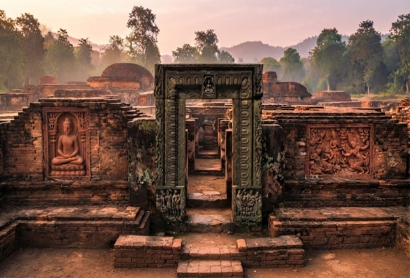
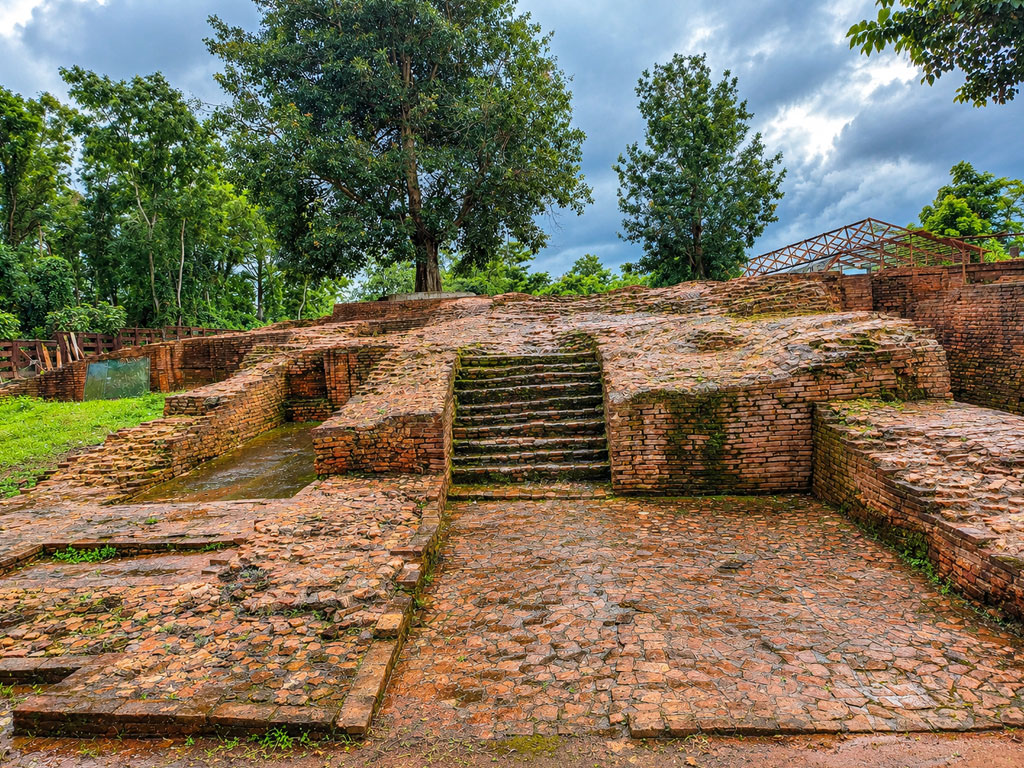
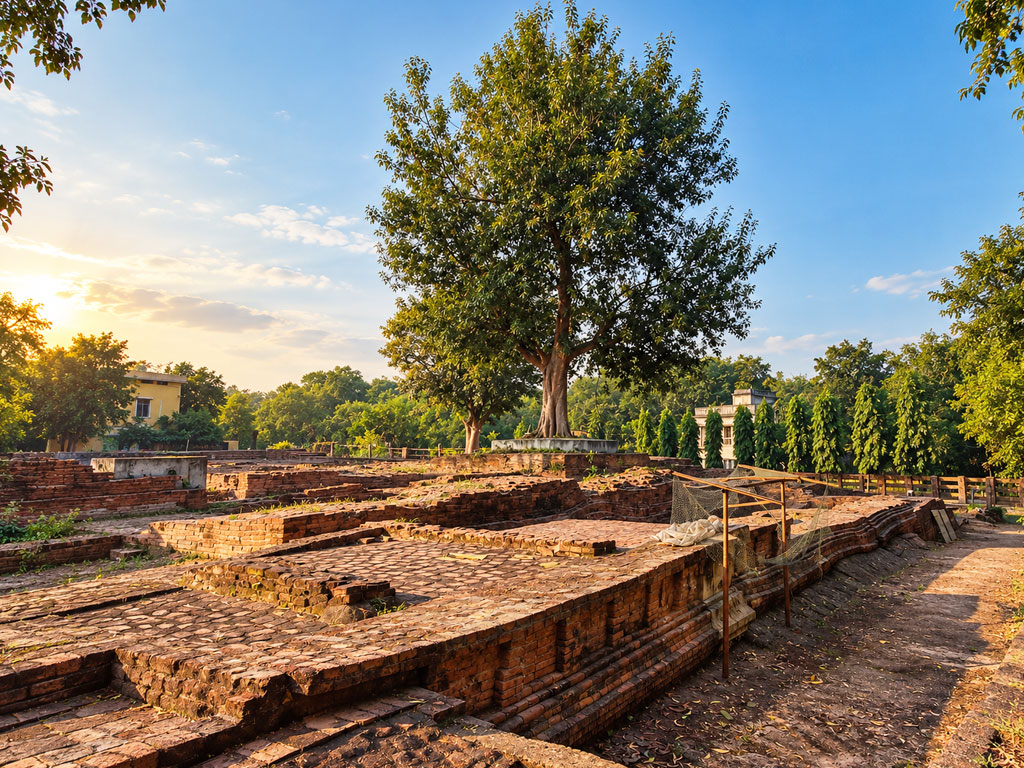
Mogalmari, an otherwise insignificant village on the south -west border of Paschim Medinipur in West Bengal, which gained instant recognition with the unearthing of a Buddhist Monastery, dating back to the 6th century CE, believed to be the oldest historical site of the state, thus gaining an immense importance. The excavation opened a new chapter in the history of Bengal in general and that of the roots of Buddhism in Bengal in particular. This Mogalmari was rediscovered by Prof. Asok Datta of Department of Archaeology, University of Calcutta in course of his research project of Indigenous navigation and he took up the excavation of this site in 2003-04. But what people do not know is that site was first reported by the famous Nagendranath Basu during one of his surveys of MAYURBHANJA District on the basis of which he wrote a book called ARCHAEOLOGICAL SURVEY OF MAYURBHANJA. He first reported the Mound of Mogalmari which is now well known as SakhisenarDhibi and for its associated archaeological features. Historians and researchers assumed that the site was a learning centre of Sakhisena, the daughter of the feudal chief Bikramkeshari.
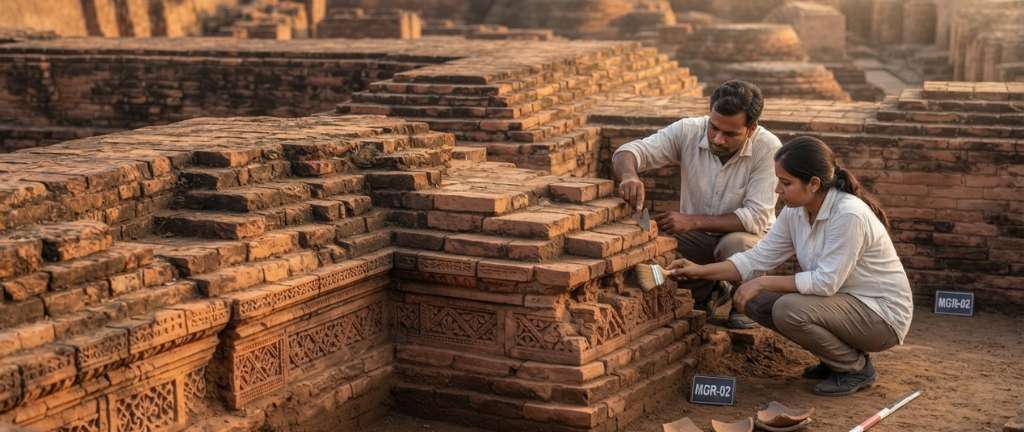
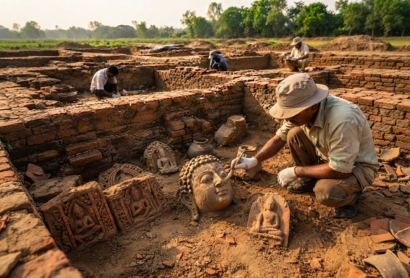
After its rediscovery by Dr. Datta, who started excavation in 2003-04 and continued for six years till 2012. The excavation unearthed the structural remains of two Monasteries, the first evidence of this kind in any part of Bengal where we have two monasteries within a single premise covered by a common boundary wall and several Archaeological artefacts which are unique in themselves. On 7th March 2013, the Directorate of Archaeology and Museums, Department of Information and Cultural Affairs, Govt. of West Bengal designated Sakhisena Dhibias a state protected monument. The excavation is now going on at this site. Excavation unearthed a Buddhist Monastery, Votive Stupa & Votive Seal, Mixed metal coin of King Samachar Deva, Gold Pendent & Crown, Bronze images of Buddha, Bodhisattva & Buddhist goddess, decorated Stucco plaster wall & images, Seal & Sealings.
An interesting event occurred during the ninth phase of excavation (2015-2016). A three-day Buddhist Heritage Festival was organised from January 24 to 26, 2016, witnessing a convergence of Buddhist monks from different parts of the world at the site. While the monks chanted, ‘Buddham Saranam Gacchami…’, the archeologists discovered 95 bronze images, out of which around 40 were of the Buddha! and others were of the Bodhisattva & Buddhist goddess. Out of the many archaeological sites across Bengal, Mogalmari is a vast site of Post Mauryan Buddhist settlement having a gigantic Buddhist monastery. It is one of the oldest Buddhist sites of Bengal. Many more features could be unearthed in the course of further excavation. This could be treated as a fine model of a typical Buddhist monastery found in Bengal.
The religious importance of this place is immense as this site reveals itself as an important seat of religious learning, inhabited by the monks in the pursuit of the path shown by the Buddha. This place has the aura of learning, discussing, chanting and simply the fact of residing by the learned and the knowledge thirsty individuals awaiting a noble goal. A rich museum displaying the priceless artefacts dug out of the vestiges of a once thriving centre of learning would add to the wider understanding of the place. This monastery did not stand in isolation. It was also connected to the other monasteries like Nalanda, Thakshashila (Taxila), Vikramashila, etc.
Very recently, some astonishing findings came to light through a research work, which previously suggested the existence of a Mahavihara at Mogalmari. But after a thorough and detailed interpretation from the inscription it was found that there were two major Learning Centres. The first was the Mahavihara called ‘Yajñapipdika mahavihara’, and the second one was ‘Mugalayika viharika’ by name. It can be claimed that the name Mogalmari is most likely to come from the Moglayik Monastery. It is clearly established here that this area had already been a Buddhist centre. Because of its historical importance it is more expedient that Mogalmari was named after an important famous and eminent Buddhist figure. The name inscribed on the seal, found in the excavation itself makes it clear that this monastery may had been named after the famous monk Mahamoudaggalayana (Moggalayan) lived during the Buddha’s times or Mogliputttissa, the famous Buddhist monk of Emperor Ashoka’s period.
On the other hand Anathapindaka was one of the richest merchants in the time of Gautam Buddha. His real name was Sudatta. He was the Buddha’s favourite disciples. He sacrificed everything for the propagation of Buddhism. His trade was conducted through the port of Tamralipta. He may have sponsored the construction of a monastery now excavated at Mogalmari village. There is a strong possibility that Anathpindaka has a relationship with ‘Yajñapipdika mahavihara’. That demand should be made clear after deciphering the monastery Seal. Since the huge area of Mogalmari is yet to be excavated, only after the complete excavation will the complete history of this ancient Buddhist region be revealed.
Bengal takes pride in unearthing and exposing her rich intellectual distant past in this representative great site called Mogalmari. Looking at the intriguing history of Mogalmari and its unique monastic culture, it is evident that the place has every possibility to become a tremendous attraction for Buddhist Tourists from all over the World. The place has already become an interesting Buddhist spot for Archaeologists and Historians. Further research and excavation can open a new chapter of Buddhist history in World. The place has all potentials to attract Buddhist tourists and researchers from all across the World, specially from nearby Buddhist countries.
Mogalmari Buddhist Site can easily attract a huge number of Buddhist tourists who visit India each year. The proximity of the place with Kolkata Netaji Subhas Chandra Bose International Airport can easily bring Buddhist tourists from South East Asian countries. Tourists who travel along the existing Buddhist Tour Circuit can easily visit Mogalmari during the course of their pilgrimage tour. But for this to happen, Mogalmari must be published and promoted. So there is a need to develop a “Tamralipta, Mogalmari and Dantapur Buddhist Tour Circuit” and should be marketed widely in the Buddhist countries. This circuit would cover the Buddhist places in West Bengal and Odhisa too, which once was part of Kalinga. Udayagiri, Lalitgiri, Ratnagiri and Pushpgiri were the Buddhist Places which flourished at the same time. These places too can be the part of this circuit, because they are not far from Tamralipta region.
History of Mogalmari Buddhist Association
The Mogalmari Buddhist Association’s history is inextricably linked to the discovery, preservation, and promotion of the ancient Buddhist site of Mogalmari, located in the Tamralipta region of West Bengal, India. While the site itself boasts a rich history dating back to the Post-Mauryan period (around the 5th-6th century CE), the Association’s formal history is more recent, emerging as a dedicated effort to safeguard and revitalize this significant heritage.
The Historical Significance of Mogalmari
To understand the Association’s origins, it’s essential to delve into the historical context of Mogalmari. The Tamralipta region, where Mogalmari is situated, was a crucial center during Emperor Ashoka’s reign. This ancient port city played a vital role in the spread of Buddhism, as it was the point from which Ashoka’s children, Mahendra and Sanghamitra, set sail for Ceylon (modern-day Sri Lanka) to propagate the Dhamma (Buddhist teachings).
The Mogalmari site, a Post-Mauryan settlement, further solidified the region’s Buddhist legacy. Archaeological excavations at Mogalmari have unearthed a 6th-century Buddhist monastery, believed to be one of the oldest historical sites in Bengal. This discovery, along with other significant finds like votive stupas, seals, gold pendants, and numerous bronze images of Buddha and other deities, revealed the site’s importance as a thriving center of Buddhist learning and artistic expression.
Ancient Chinese travelers Fa-Hien and Hiuen Tsang documented the presence of numerous Buddhist monasteries in the Tamralipta region, further attesting to the area’s prominence in the history of Buddhism. While many of these monasteries remain undiscovered, the excavation of Mogalmari provides tangible evidence of the region’s rich Buddhist past.
The Genesis of the Association
The discovery of the Mogalmari site and its subsequent archaeological significance spurred the formation of the Mogalmari Buddhist Association. The realization of the site’s historical and cultural value, coupled with the need for its proper preservation and promotion, led to the establishment of this organization.
The Association’s origins can be traced to a growing awareness among scholars, archaeologists, and local communities about the importance of Mogalmari. Recognizing the site’s potential to shed light on Bengal’s Buddhist heritage and its ability to attract Buddhist pilgrims and tourists, a dedicated group came together to form the Association.
Key Milestones and Development
- Site Preservation: A primary focus of the Association has been to work towards the preservation of the Mogalmari site. This involves collaborating with archaeological experts, government agencies, and local communities to protect the site from environmental threats, encroachment, and neglect.
- Research and Documentation: The Association has actively supported and promoted research and documentation efforts at Mogalmari. This includes facilitating archaeological excavations, scholarly studies, and the publication of findings to enhance understanding of the site’s history and significance.
- Promotion of Buddhist Teachings: The Association has played a vital role in promoting Buddhist teachings and philosophy, recognizing Mogalmari as a center for spiritual learning. This involves organizing educational programs, workshops, and seminars to disseminate Buddhist wisdom.
- Cultural Outreach: The Association has organized cultural events and festivals to celebrate the rich heritage of Mogalmari and its connection to Buddhism. These initiatives aim to raise awareness about the site and its cultural significance among a wider audience.
- International Collaboration: The Association has fostered collaboration with international organizations, scholars, and practitioners to promote the study and preservation of Mogalmari’s heritage on a global scale. This includes partnerships with institutions and individuals dedicated to Buddhist studies and cultural heritage preservation.
- Community Engagement: The Association has worked closely with local communities to ensure their involvement in the preservation and sustainable development of the site. This approach recognizes the importance of community participation in safeguarding cultural heritage.
A Growing Global Presence
The Mogalmari Buddhist Association has steadily expanded its reach beyond regional boundaries, establishing a growing global presence. The Association has attracted members from 14 countries, demonstrating its international appeal and its commitment to fostering cross-cultural exchange.
The Association’s participation in international forums, such as the II International Buddhist Forum in Ulan-Ude, Russia, further highlights its efforts to engage with the global Buddhist community and share its expertise on an international platform.
The Association's Vision
The Mogalmari Buddhist Association envisions a future where the Mogalmari site is recognized as a prominent international center for Buddhist learning, pilgrimage, and cultural exchange. The Association strives to connect the site’s profound spiritual legacy with the contemporary world, ensuring that its wisdom continues to inspire and guide future generations.